
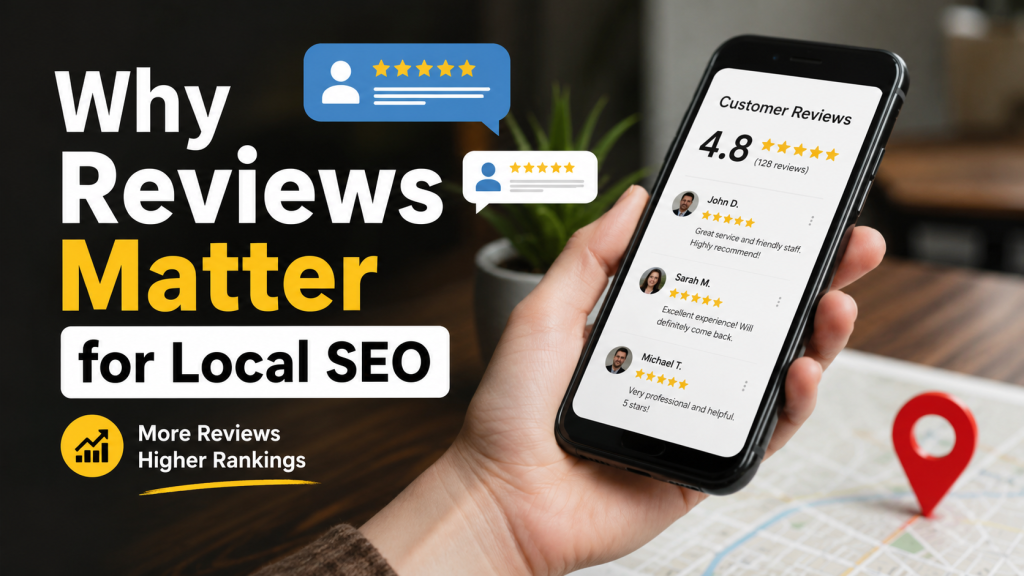
If you run a local business — a restaurant, a dental clinic, a plumbing company, a boutique gym — you’ve probably heard that “reviews matter.” But most business owners underestimate just how much weight customer reviews carry in local search rankings. Reviews aren’t just social proof for your customers; they’re one of the strongest ranking signals Google uses to decide which businesses show up in the coveted Local Pack (the map and three-listing block that appears for searches like “coffee shop near me” or “plumber in Austin”).
In this post, we’ll break down exactly why reviews matter for local SEO, how they influence rankings, and what you can do to turn reviews into a real competitive advantage.
What Is Local SEO, and Why Do Reviews Fit Into It?
Local SEO is the practice of optimizing your online presence so your business appears when people search for products or services near them. Unlike traditional SEO, which focuses heavily on website content and backlinks, local SEO also factors in things like your Google Business Profile, local citations, proximity to the searcher, and — critically — reviews.
Google’s own guidance confirms that review count and review score are factored into how local results are ranked, alongside relevance and distance. In other words, reviews aren’t a “nice to have” — they’re baked directly into the algorithm.
The Three Pillars of Local Ranking (And Where Reviews Fit)
Google generally evaluates local rankings based on three factors:
- Relevance – How well your business profile matches what someone is searching for.
- Distance – How close your business is to the searcher or the location they specified.
- Prominence – How well-known and reputable your business is, both online and offline.
Reviews sit squarely inside “prominence.” A business with hundreds of positive, recent, keyword-rich reviews signals to Google that real customers trust and engage with it. A business with three reviews from 2019 signals the opposite — even if the website is technically well-optimized.
Why Reviews Influence Rankings
1. Reviews Provide Fresh, User-Generated Content
Google rewards freshness. Every time a customer leaves a review, it adds new, relevant content to your Google Business Profile. This ongoing stream of activity tells Google your business is active and engaged with customers — something a static website can’t replicate on its own.
2. Reviews Often Contain Keywords Naturally
When customers write reviews, they frequently mention specific services, products, or locations without even trying to “optimize” anything. A review that says “Best emergency plumber in Denver, fixed our burst pipe in an hour” naturally reinforces relevance for searches like “emergency plumber Denver.” This organic keyword reinforcement is something you can’t easily fake through on-page SEO alone.
3. Review Volume and Velocity Signal Popularity
It’s not just about having good reviews — it’s about having a healthy, ongoing flow of them. Google pays attention to review velocity (how frequently new reviews come in). A steady trickle of new reviews looks more natural and trustworthy than a huge spike followed by silence, which can actually raise red flags.
4. Star Ratings Impact Click-Through Rates
Even if two businesses rank next to each other in the Local Pack, the one with a 4.8-star rating and 300 reviews will almost always get more clicks than the one with a 3.2-star rating and 12 reviews. Higher click-through rates send positive engagement signals back to Google, which can further reinforce your ranking over time.
5. Responding to Reviews Builds Trust and Signals Activity
Replying to reviews — both positive and negative — shows Google (and potential customers) that your business is actively managed and cares about customer experience. Thoughtful responses to negative reviews can also mitigate reputational damage and demonstrate accountability.
How to Build a Strong Review Strategy
- Make it easy to leave a review. Send a direct link via text or email after a purchase or appointment.
- Ask at the right moment. Request reviews right after a positive interaction, like a completed service or a great in-store experience.
- Respond to every review. Thank happy customers and address concerns from unhappy ones professionally.
- Never buy or fake reviews. Google actively detects and penalizes fake review patterns, and it can tank your entire profile’s credibility.
- Diversify your platforms. While Google reviews carry the most local SEO weight, reviews on Yelp, Facebook, and industry-specific sites (like Healthgrades or Houzz) also contribute to your overall online reputation and can appear in search results.
The Bottom Line
Reviews are no longer optional for businesses trying to rank locally. They directly influence your visibility in the Local Pack, shape whether searchers click on your listing over a competitor’s, and build the kind of trust that converts searchers into customers. If your local SEO strategy doesn’t include a deliberate, ongoing review-generation plan, you’re leaving one of the most powerful ranking signals untouched.
Ready to Rank Higher in Local Search?
Customer reviews are just one piece of a successful Local SEO strategy. If you want to improve your Google Maps rankings, attract more local customers, and grow your business, our team is here to help. Contact us today for a free Local SEO consultation and discover how we can boost your online visibility.
FAQ
Q: How many reviews do I need to rank well in local search? There’s no magic number, but businesses that consistently rank well in competitive markets often have review counts well into the hundreds. What matters more than a specific number is having more reviews than your closest competitors, along with steady, ongoing review activity.
Q: Do negative reviews hurt my local SEO? A few negative reviews won’t ruin your rankings — in fact, a perfect 5-star rating with very few reviews can look suspicious. What matters more is your overall average rating and how you respond to negative feedback. Ignoring negative reviews, however, can hurt both your reputation and your rankings.
Q: Which review platform matters most for local SEO — Google, Yelp, or Facebook? Google reviews carry the most direct weight for local SEO because they live inside your Google Business Profile, which powers the Local Pack. That said, reviews on other platforms can still influence your overall online reputation and may appear in relevant searches.
Q: Can I ask customers to leave reviews? Yes, and you should. Asking for reviews is completely acceptable and encouraged. What’s not allowed is offering incentives (discounts, free products) in exchange for positive reviews, or asking employees/family members to post fake reviews.
Q: How quickly will new reviews impact my rankings? There’s no fixed timeline, since Google’s algorithm considers many factors together. However, businesses that build a steady, ongoing review pipeline often see gradual improvements in visibility over weeks to months, especially when combined with other local SEO efforts like citation building and Google Business Profile optimization.
Q: What should I do about fake negative reviews from competitors or trolls? Report them directly through your Google Business Profile dashboard. Google does remove reviews that violate its policies, though the process can take time. In the meantime, respond calmly and factually to the review so other customers see you handled it professionally.
